Engagement & Bridal
Engagement Rings Ready to Ship Women's Wedding Bands Men's Wedding Bands Design a Bespoke Ring Solitaire Rings Hidden Halo Rings Three-Stone Rings Toi et Moi RingsFine Jewellery
All Fine Jewellery The Tennis Edit The Evermore Collection Diamond Studs & Earrings Necklaces & Pendants Bracelets Ready to GiftThe Rise of the Moval: 2026's Most Talked-About Diamond Shape
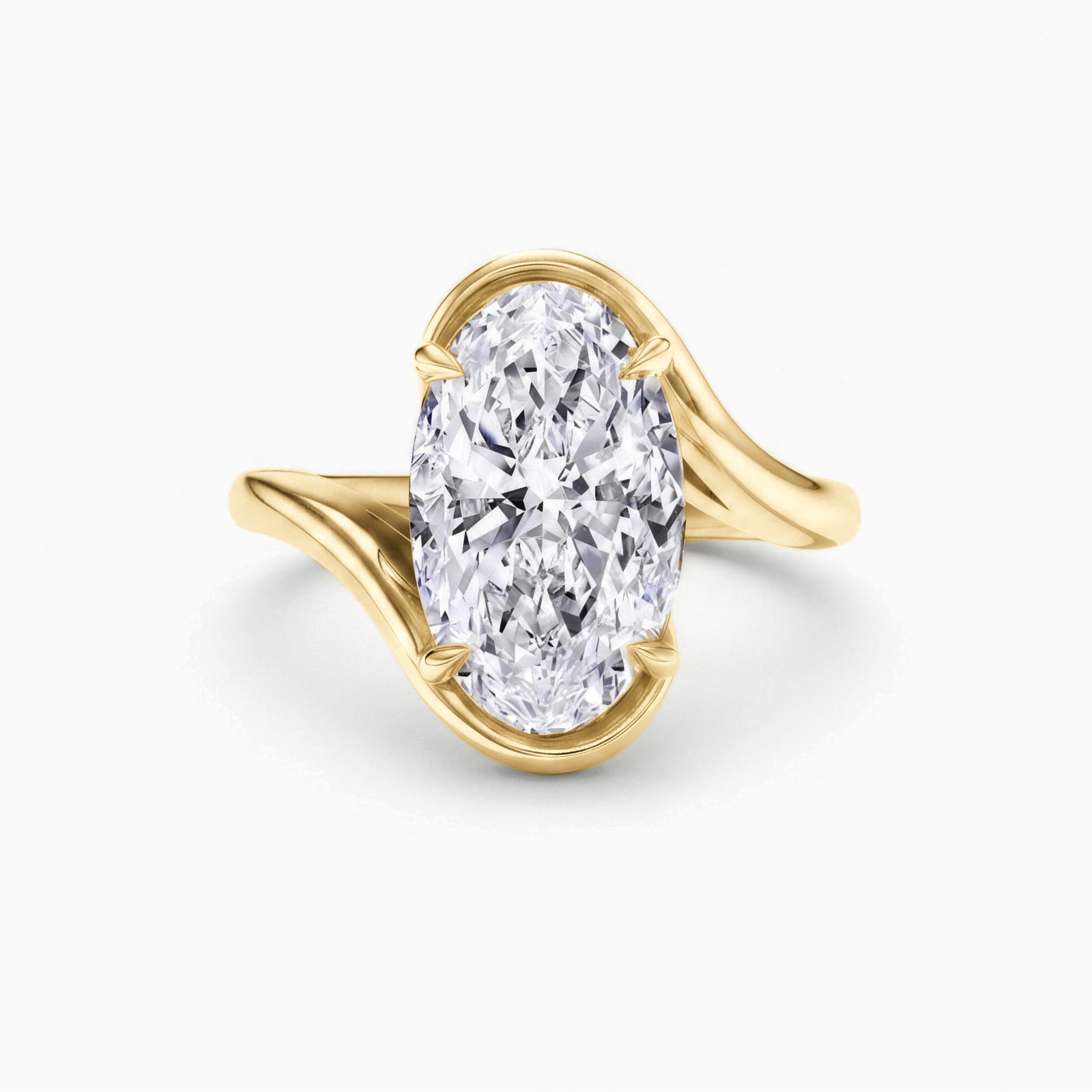
What is a moval diamond?
A moval is exactly what the name suggests: part marquise, part oval. Take the soft, rounded body of an oval and draw its ends out toward the gentle taper of a marquise, stopping just short of the marquise's sharp points, and you have a moval: a beautifully elongated oval shaped diamond that belongs entirely to itself.
It is cut as a brilliant, so it carries the same lively fire as its two parent shapes, and because the ends taper without ever becoming true points, there is no fragile tip to protect. A moval sets like an oval and sparkles like one too, just longer, leaner and far less expected.
It is also genuinely rare. Movals are almost never mass-produced, because the elongated outline wastes more rough crystal than a cutter planning for yield will usually accept. Most movals in existence were either cut a century ago, or cut to order last month.
Why is everyone suddenly talking about movals?
Three currents met at once.
First, the long reign of the oval. It has been the most requested shape at our bench for years, and once a shape becomes that popular, a certain kind of client starts asking what nobody else has yet. The moval is the natural next step: unmistakably oval in spirit, unmistakably different in person.
Second, the marquise revival. Trend forecasters have named elongated cuts, the oval, the marquise and the moval hybrid between them, as the most requested engagement ring shapes for 2026, and several of the industry's better-known ateliers now describe the moval as the next must-have. Even Hailey Bieber's famous ring is so elongated that half the internet insists it is a moval rather than an oval, which tells you where taste is heading.
Third, and most practically: lab-grown diamonds. When a shape wastes rough, the waste is priced into the stone. With lab-grown rough, cutting the outline you actually want stopped being an extravagance, and a shape that was once a collector's hunt became something a Brisbane workshop can source, certify and set. The moval did not change. The arithmetic did.
Moval vs oval vs marquise
The easiest way to place the moval is by its length-to-width ratio, the number you get by dividing a stone's length by its width:
| Shape | Typical ratio | The ends | The character |
|---|---|---|---|
| Oval | 1.30 to 1.50 | Fully rounded | Soft, classic, universally flattering |
| Moval | 1.60 to 2.00 | Softly tapered, no points | Elongated, sculptural, quietly rare |
| Marquise | 1.85 to 2.10 | Two sharp points | Dramatic, vintage, maximum spread |
Toward the lower end of its range a moval reads like a particularly elegant elongated oval. Toward the upper end it borrows the drama of a marquise without the points. The stone we chose for our own moval sits in the heart of that range, where the shape is unmistakably its own.
One certificate quirk worth knowing: the word moval will not appear on the paperwork. Laboratories file hybrid outlines under their modified brilliant categories, and no laboratory issues a cut grade for any fancy shape. That is not a red flag, it is simply how fancy shapes are graded, and it is why a moval should always be judged on video and in motion, not from a certificate or a still photo.
Does a moval diamond have a bow tie?
This is the question we hear most, and the honest answer is: it can, like every elongated brilliant cut, ovals and marquises included. The bow tie is a dark, bow-shaped shadow across the centre of a stone, and it is caused by facet misalignment and poor proportions, not by the shape itself.
A well-cut moval keeps the bow tie so faint it reads as contrast rather than shadow, which is part of what makes the stone feel alive. This is exactly why we select every elongated stone by eye and send you a video of your exact diamond before a single claw is set.
Do movals look bigger than other diamonds?
Yes, noticeably. Elongated shapes carry more of their weight in the face of the stone, so a moval spreads further across the finger than a round of the same carat and edges out even an oval. The taper toward each end also lengthens the finger the way a marquise does, which is why the shape is so often recommended for anyone who wants presence without bulk.
If maximising face-up size per dollar is the goal, the moval sits in genuinely elite company, and it does it while looking like nothing else in the room.
How much does a moval diamond ring cost?
It depends almost entirely on how the stone comes to exist. Natural movals are scarce enough that buyers on collector forums describe the search in years, and well-cut examples command a premium over comparable ovals simply because someone had to sacrifice rough to cut one.
Lab-grown movals rewrote that. The stone in our Luna is a 4.00 carat IGI certified lab-grown moval, and the finished ring, stone included, costs $12,600. A natural diamond of that size and grade would cost several times more before it was ever set. As with everything we make, the price is the finished ring, diamond included.
The Luna: our moval
We loved this shape enough to build a ring around it. The Luna holds a 4.00 carat IGI certified lab-grown moval in 18ct yellow gold, on a sweeping band that rises and wraps around the stone in delicately sculpted claws. Fluid, modern and quietly sculptural, it wears like nothing else on the hand, and as pictured, it is ready to be someone's.
Prefer a different carat, metal or setting around a moval? That is precisely what our custom design service is for: we source certified moval stones to order, show you your exact diamond on video, and hand-craft the ring at our Edward Street workshop in around three weeks.
Frequently asked questions
Is a moval the same as an elongated oval?
Close cousins, not twins. An elongated oval keeps fully rounded ends however long it gets. A moval's ends taper toward the soft suggestion of a point, which is what gives it the marquise character. In practice the boundary blurs, and plenty of stones sold as elongated ovals are movals in all but name.
Is a moval diamond good for an engagement ring?
Excellent. It has no sharp points to chip, so it needs no special protective setting, it wears comfortably every day, and its spread flatters almost every hand. Its real risk is social: expect to spend the first year explaining what it is called.
What length-to-width ratio should a moval have?
Most sit between about 1.6 and 2.0. Lower reads fuller and closer to an oval; higher reads leaner and closer to a marquise. There is no correct number, only the proportion that suits the hand wearing it, which is a decision best made in person.
Can you get a lab-grown moval diamond?
Yes, and lab-grown is precisely what turned the moval from a collector's hunt into an attainable centre stone. Every moval we set is a certified lab-grown diamond, graded by IGI or GIA, chemically and optically identical to a mined stone.
Will a moval date?
The shape is over a century old: cutters were experimenting with marquise-oval hybrids in the Edwardian era, and antique movals still trade eagerly at auction. What is new is the attention, not the cut. Shapes with that kind of history tend not to date, they tend to wait.
The honest way to decide is on the hand. Book a free consultation at our Brisbane atelier or by video and see the moval next to an oval and a marquise under the same light, or meet the Luna first. For the wider tour of every shape we cut, our diamond shapes guide is the place to start.
Every ring starts with a conversation.
Bring the questions this guide raised to a free consultation at 150 Edward Street, or begin a custom design from anywhere in the world.
Begin Your Custom Ring